Our workOperating system
We run on the system we write about.
At our operating company, agents brief the leadership team every weekday morning. They read the CRM, the support desk, product usage, the books, customer calls and the market, then write reports that take a position, show their sources and recommend the next move. The reports read each other. People make the calls.
How it flows
The reports read each other.
Each report writes a structured record, and later reports read it. Scorekeeping runs early in the week, the assists act on it the same morning, and Friday’s digest reads ten of them. The following Tuesday, the scorecard reads them again to explain why each number moved.
- Mon
- Market Scan
- Operating Newspaper
- Tue
- Growth Reality
- Pipeline Reality
- Prospecting Reality
- Sales CEO Assistreads Pipeline Reality and Prospecting Reality
- AE Week Aheadreads Pipeline Reality and Prospecting Reality
- Wed
- Support Reality
- Onboarding Reality
- Support CEO Assistreads Support Reality and Onboarding Reality
- Thu
- Product + Engineering Realityreads Support Reality and Pipeline Reality
- Finance Realityreads Pipeline Reality
- Fri
- Voice of Marketreads Market Scan, Operating Newspaper, Growth Reality, Pipeline Reality and Support Reality
- Weekly CEO Digestreads Market Scan, Operating Newspaper, Growth Reality, Pipeline Reality, Prospecting Reality, Support Reality, Onboarding Reality, Product + Engineering Reality, Finance Reality and Voice of Market
- Editorial retroreads Weekly CEO Digest and Voice of Market
- Tue · next week
- Executive Scorecardreads Weekly CEO Digest, Growth Reality, Pipeline Reality, Support Reality, Product + Engineering Reality and Finance Reality
Every report reads from the CRM · the support desk · product usage · the books · customer calls · market feeds
Six sample editions, in run order
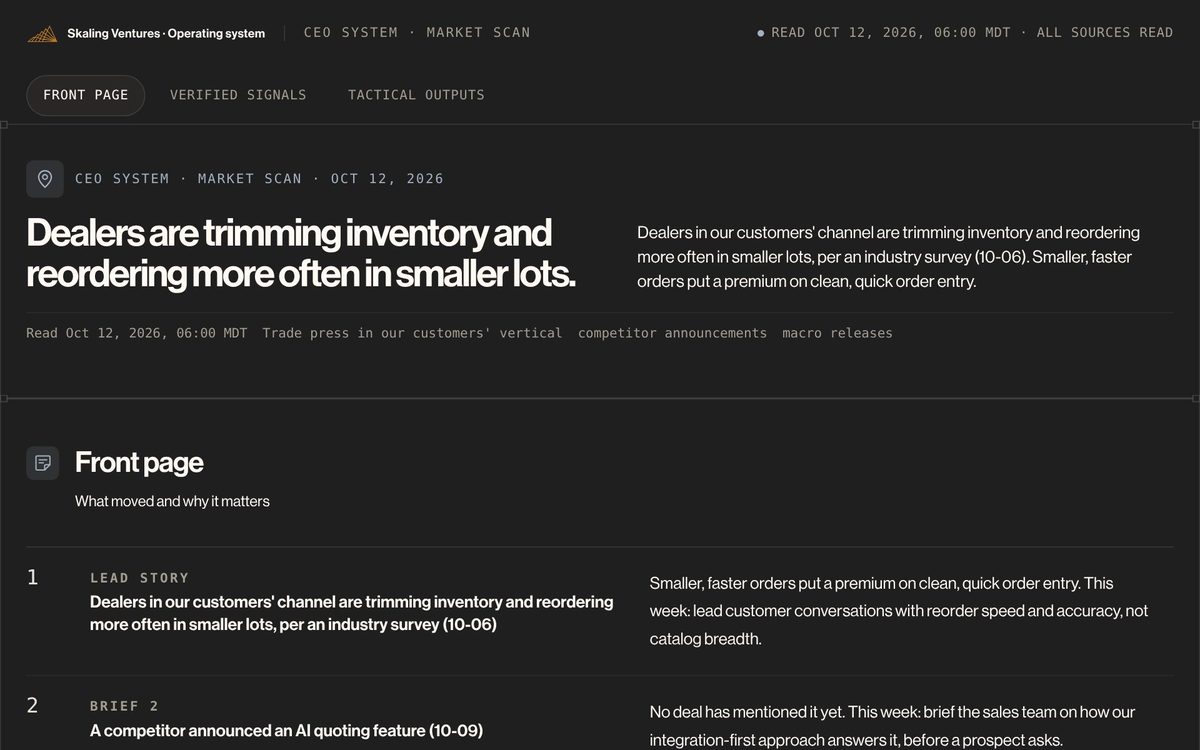
Market Scan
“Smaller, faster orders put a premium on clean, quick order entry.”
Reads the trade press and competitors in our customers’ vertical, takes a stance for each part of the channel, and hands each team a move for the week.
ReadsLive systems and outside sources only
Read byVoice of Market and Weekly CEO Digest
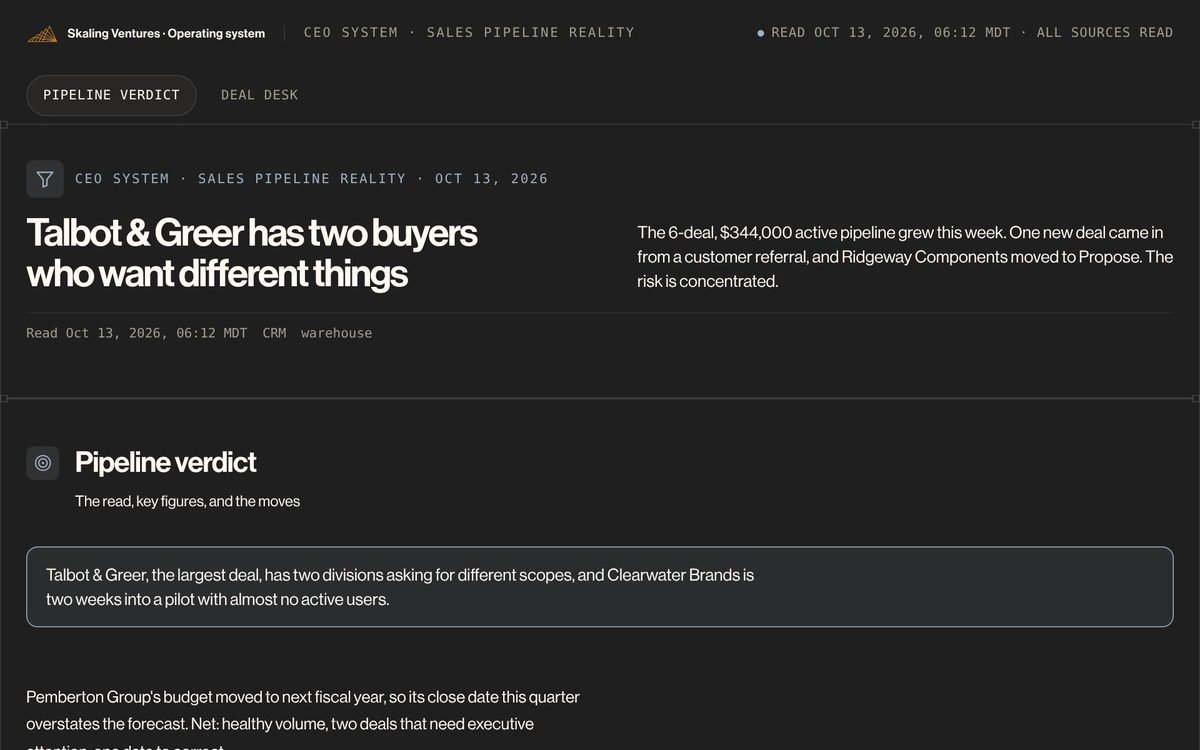
Sales Pipeline Reality
“Talbot & Greer has two buyers who want different things.”
Keeps score without spin: facts kept apart from inference, each deal checked against the evidence, every next move dated. Seven later reports read it.
ReadsLive systems and outside sources only
Read bySales CEO Assist, AE Week Ahead, Product + Engineering Reality, Finance Reality, Voice of Market, Weekly CEO Digest and Executive Scorecard
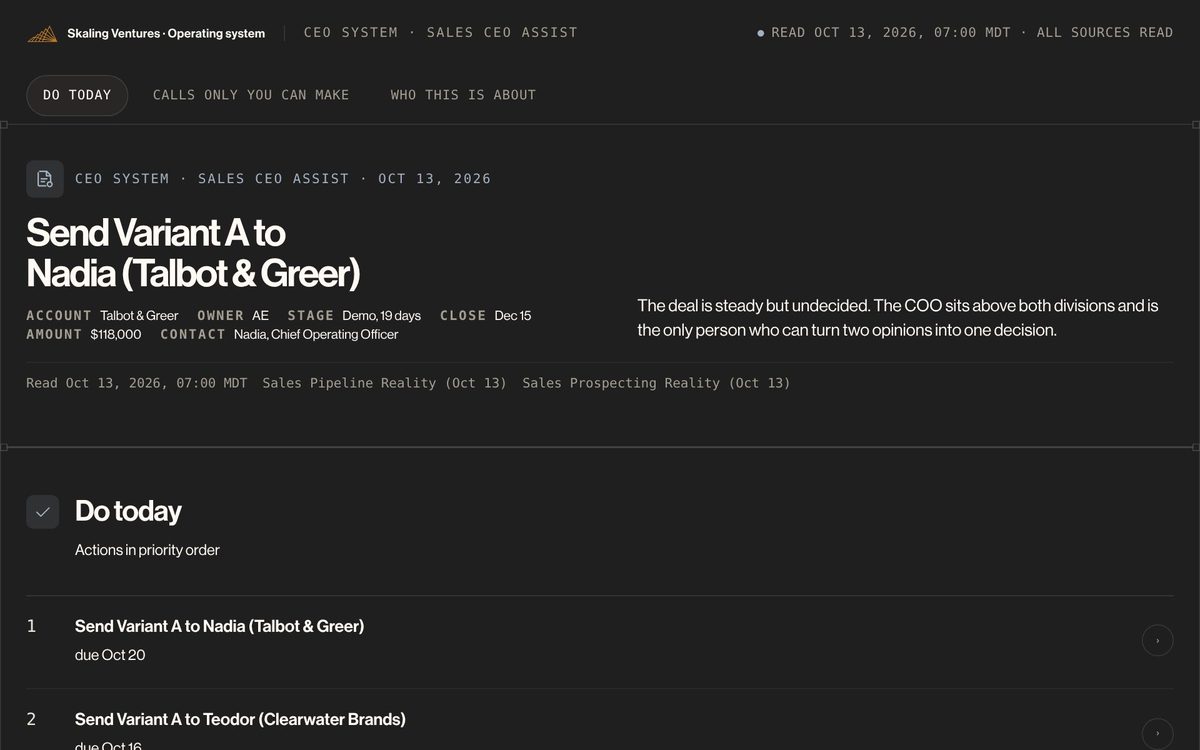
Sales CEO Assist
“The COO sits above both divisions and is the only person who can turn two opinions into one decision.”
Reads Pipeline Reality and turns it into the calls only the CEO can make, with notes drafted in three tones and a rule for when to send each.
ReadsPipeline Reality and Prospecting Reality
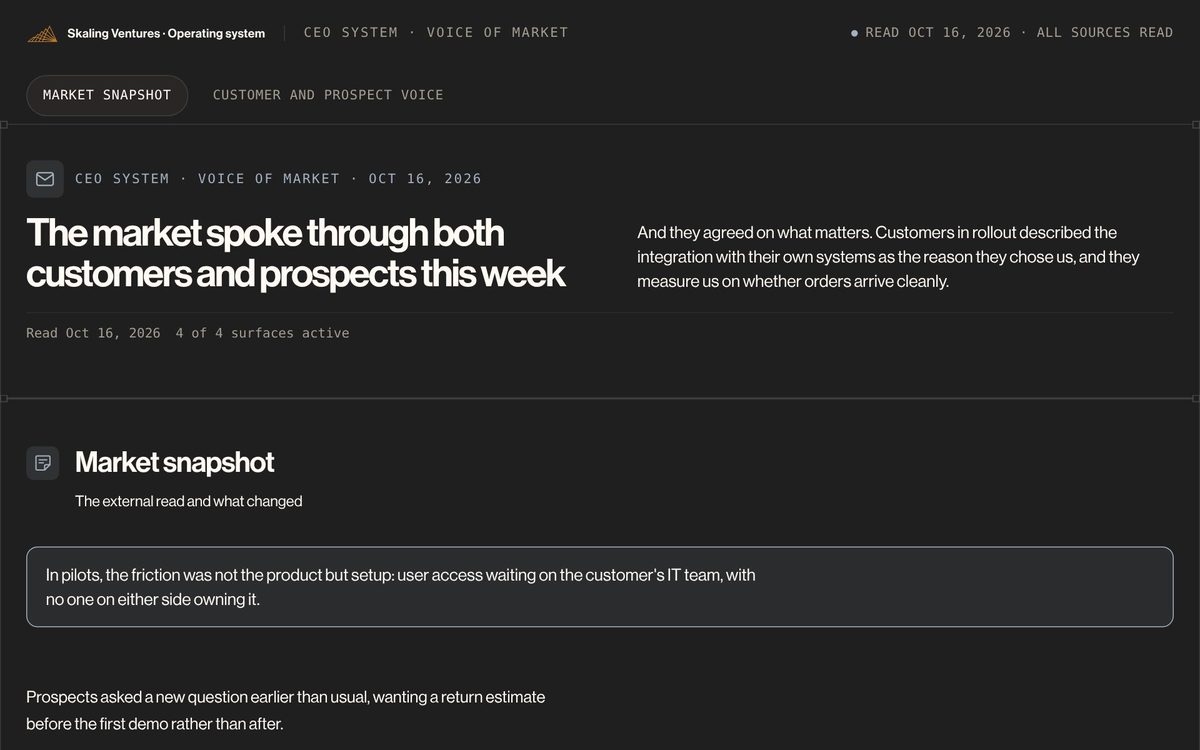
Voice of Market
“Customers buy the integration, and judge us on it.”
Reads the week’s customer and prospect calls alongside the market, support, growth and pipeline reports, and shows where the sales story and customer reality agree or split.
ReadsMarket Scan, Operating Newspaper, Growth Reality, Pipeline Reality and Support Reality
Read byWeekly CEO Digest and Editorial retro
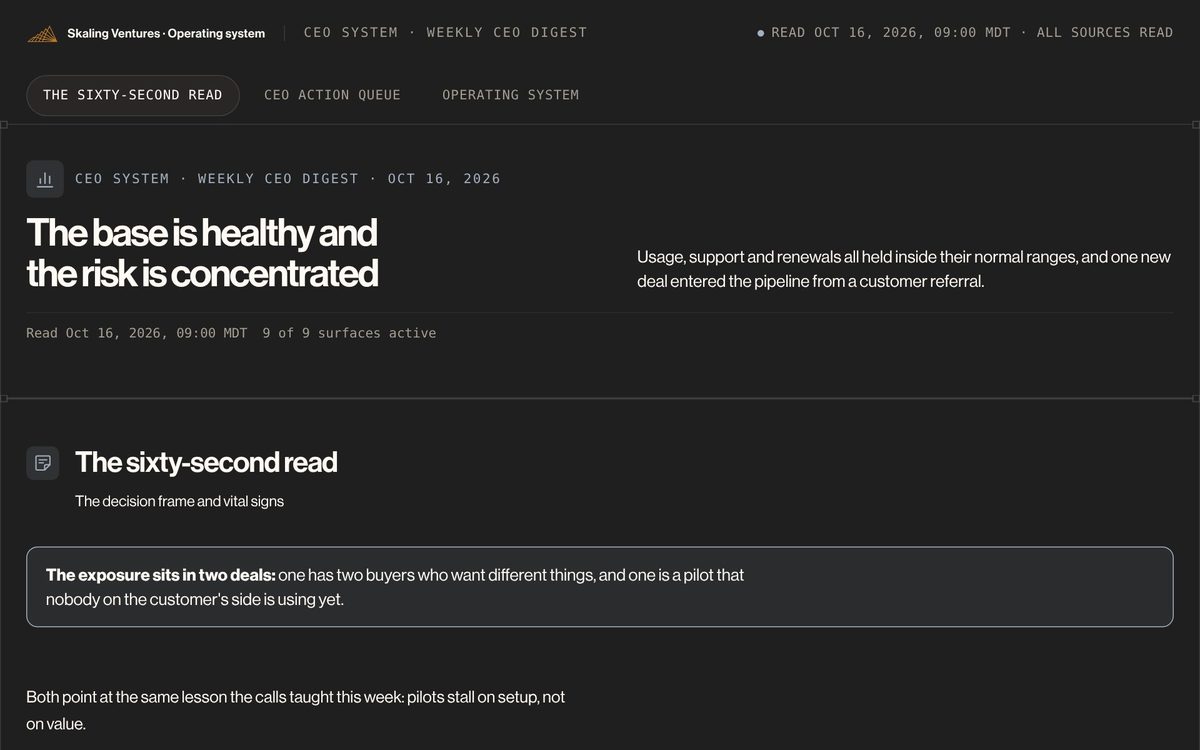
Weekly CEO Digest
“The base is healthy and the risk is concentrated.”
Reads ten reports from the week and writes one view across the business: the verdict, the vital signs, the patterns no single report can see, and a ranked action list for the CEO.
ReadsMarket Scan, Operating Newspaper, Growth Reality, Pipeline Reality, Prospecting Reality, Support Reality, Onboarding Reality, Product + Engineering Reality, Finance Reality and Voice of Market
Read byEditorial retro and Executive Scorecard
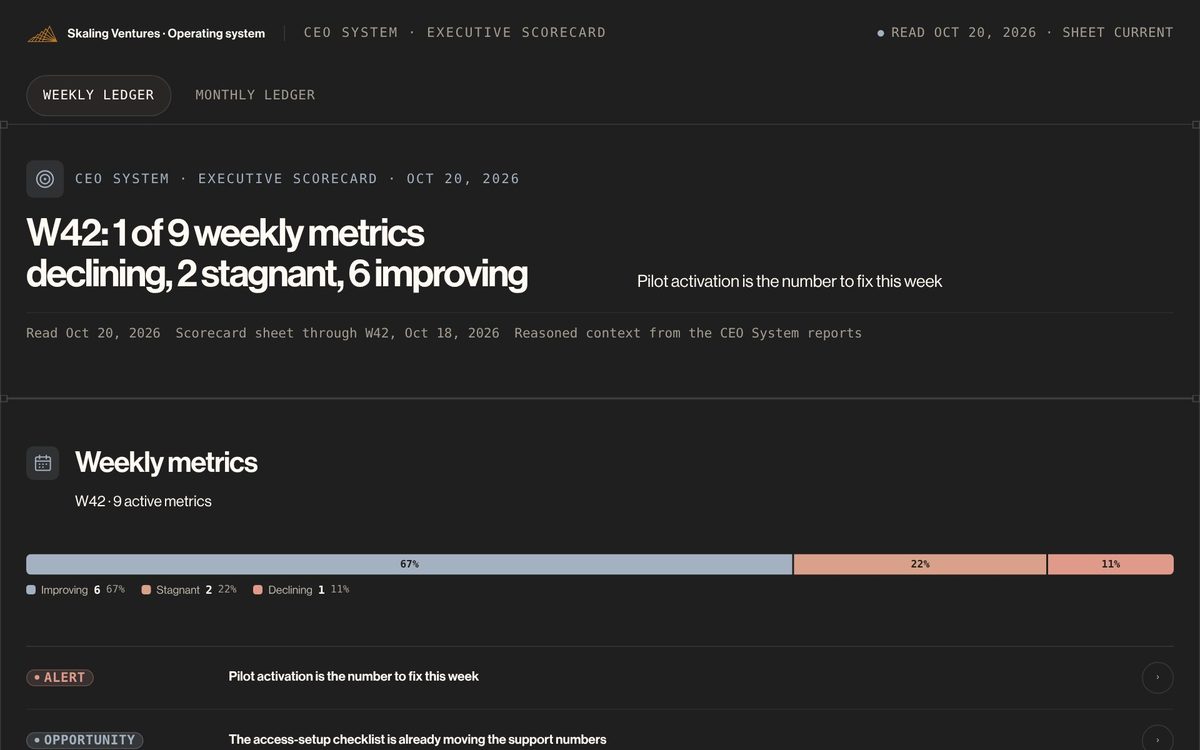
Executive Scorecard
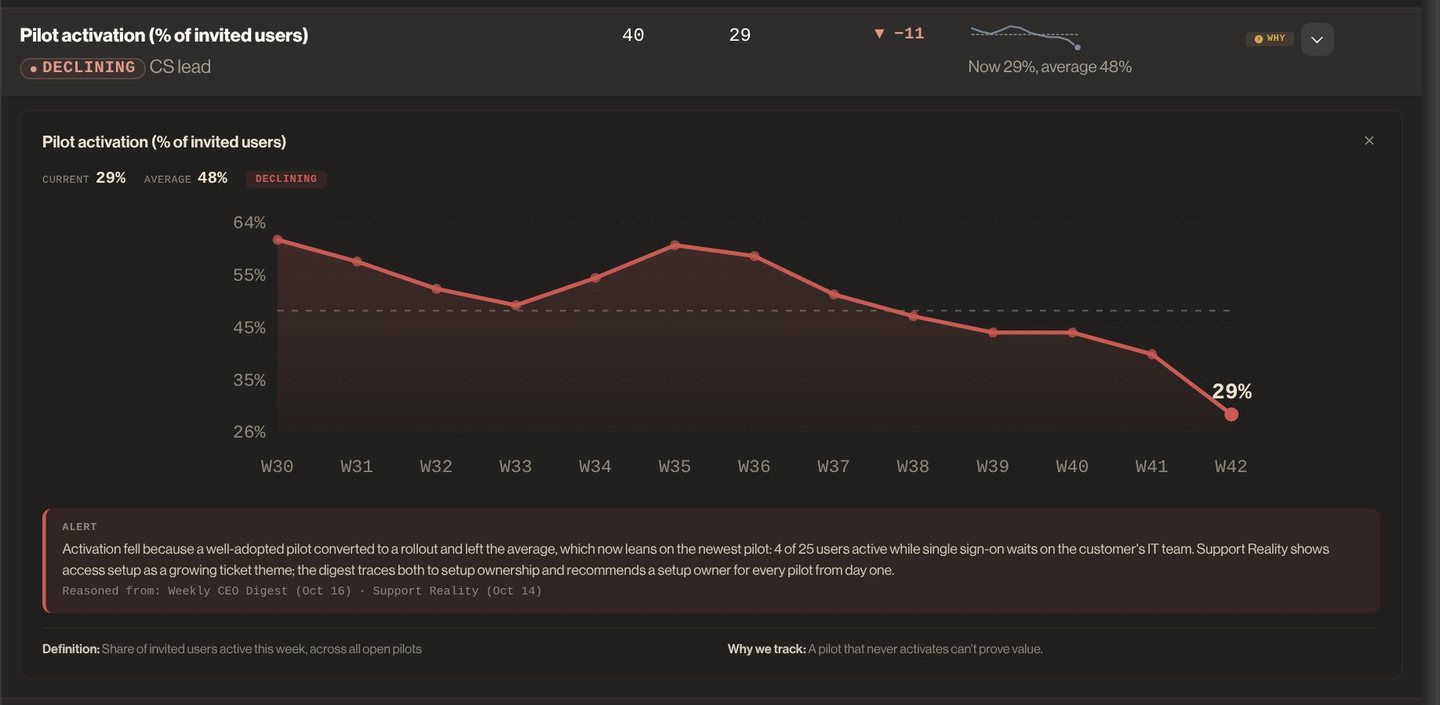
“Activation fell because a well-adopted pilot converted to a rollout and left the average, which now leans on the newest pilot.”
Grades the weekly leading metrics and the monthly lagging ones, then reads the digest and the functional reports to say why the big movers moved, and which report says so.
ReadsWeekly CEO Digest, Growth Reality, Pipeline Reality, Support Reality, Product + Engineering Reality and Finance Reality
Sample editions: the system’s real format, templates and kind of reasoning, with invented names, figures and situations. None of it describes a real customer. Each sample is rendered by the system’s own templates and trimmed to a reader’s cut; the live editions are several times longer and stay private. Two notes on the map: the Operating Newspaper reads the wider software market for us as owners, not our customers’ market; and on Sunday an outcome diagnosis, not shown, checks the quarter’s bets against the week’s reports.
Anatomy of a report
Built to be argued with.
Every report is laid out so a reader can disagree with it quickly: the claim first, then the evidence, then where the evidence came from.
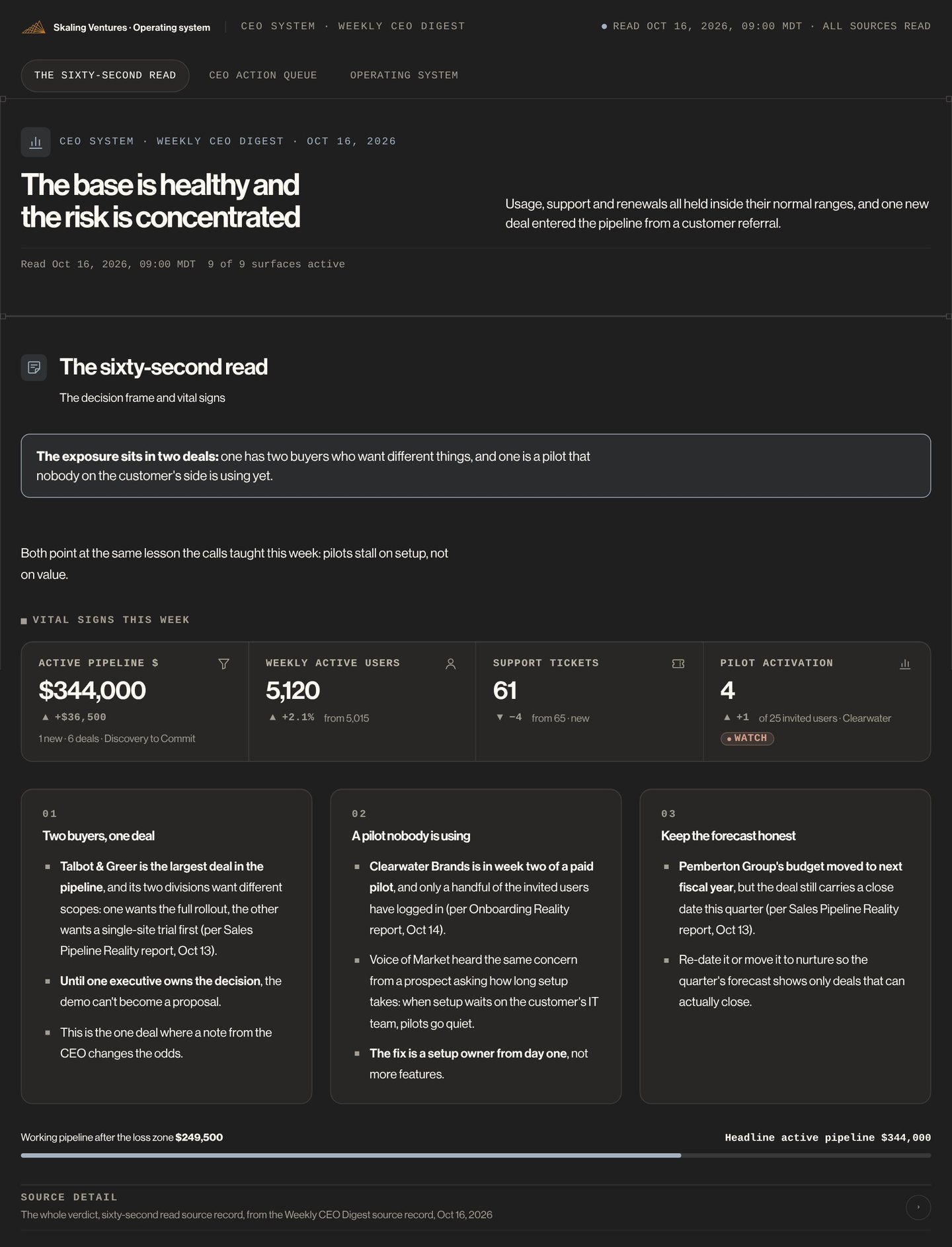
- The verdictIt opens with a position, not a summary. If the week was mixed, the first line says so.
- What it readWhen it read the data, how many sources it covered, and a flag when one of them is partial.
- Vital signsThis week against last, with the normal range where one exists, so a seasonal dip reads as one.
- Three things that matterRanked, each ending in what it means for the week.
- One report citing another“per Sales Pipeline Reality report, Oct 13” The digest reads the week’s reports and says which one each claim came from.
- The source recordEvery section opens to the structured record behind it. Nothing on the page is unsourced.
And the numbers
Every big move arrives with its reason.
Most scorecards say a number went down. Ours says why, in a sentence written from the reports upstream: here, the digest and Support Reality, named and dated under the explanation.
- The trend twelve periods of history against the average, so one bad week reads as one.
- Leading and lagging weekly signals sit above the monthly results they lead to. In the sample, rising access-setup tickets show up a month later as slower time to first value.
- The why written by an agent that reads the week’s reports, not the sheet alone.
- The checks a lint catches claims about the wrong week, and a second pass checks each claim against the reports it cites.
How it stays honest
The harness does the work the model can’t.
A model writes well. Whether its report deserves trust depends on everything around it: what it may read, what it must check, and what happens when it’s wrong.
- 01Read
Agents read the source systems and the reports upstream of them, under versioned prompts, and write a structured record rather than free text.
- 02Check
Checks fail closed: a report that fails its render checks doesn’t publish. A partial source is flagged on the page, not hidden.
- 03Publish
Reports land through the morning in dependency order, each carrying its own freshness and coverage line.
- 04Grade
Every Friday an editorial retro reviews the week’s reports. Separately, the CEO records what a report missed.
- 05Remember
The CEO’s feedback is stored and read by the next run, so it starts from what the last one got wrong.
Then Monday starts again, a little sharper. Changes to the report templates run against a fixed set of test cases before they ship.
Every action has a human owner. Drafted notes wait for a person to send them.
A partial source is flagged on the page, and an empty section stays empty rather than guessed.
This runs at our current operating company. We write about what it takes in The Harness Is Where the Work Is ↗
Built for operators who want the truth early.
If you’ve built something durable in a specialized market and want to talk about what comes next, we’d like to hear from you.